
Abode with Me: Abandoned churches may be blessings in disguise for intrepid home buyers seeking design inspiration
What happens to a church when the congregation has gone? Over the past few decades, the Western world has seen a steady decrease in church attendance, leading to many places of worship shutting their doors. Three years ago, it was predicted that some 100,000 of the estimated 380,000 to 420,000 churches currently operational in the US were doomed to close in the near future. According to another forecast, as many as 15,000 American churches could fall into disuse within this year.
Hundreds of church buildings that were once revered now stand derelict, in want of attention and new adoration. Late last year, the Chicago Tribune reported that more than 30 church properties in the Archdiocese of Chicago had been listed for sale. The lucky ones may undergo conversion and be born again as centres of business. Rechristening can take place in a variety of creative forms, from restaurants and pubs to dance studios and art spaces, and even in one instance, a circus school.
It is perhaps less common to redevelop churches into residences, since converting a typically cavernous, single-room historical structure into a safe, comfortable home with the necessary lighting, water and heating for full-time occupation requires a substantial investment. Preserving the integrity and grandeur of their original features, like arched doors and windows, stained glass, vaulted ceilings, domed roofs or spires, brings further costs and design headaches. Those inspired homeowners and architects who do accomplish this feat are to be praised.

Almost a decade ago, a then neighbourhood news platform stated that some 20 churches in Chicago had been turned into apartments or family homes. One of these was particularly stylish – a seven-bedroom, six-bathroom conversion featuring pristine white interiors that garnered a bagful of international accolades, including an American Institute of Architects’ Small Projects Award.
The original edifice was built by an Italian architect in 1901 as a Methodist church, though it served the devout for less than 20 years before putting out the last candle. It had previously been converted into offices and then two separate residences. Turning it into a single 5,500-square-foot home for an adventurous couple with three young children fell into the hands of Chicago-based artist-designer Linc Thelen.
“What really made this project stand out to everybody was it’s so contemporary and current but in the envelope of a church,” said Thelen in an interview after the project was completed in 2015. “We were able to add more rooms, but enlarge them in other areas so it didn’t lose that lofty feel. [We were] able to accomplish something very current in design, that was fluid, that worked, that didn’t look gimmicky.”
Thelen, who studied both art and architecture and has shown his paintings in Hong Kong, takes the ‘master builder’ approach to his projects. Here, he worked in collaboration with Scrafano Architects, a firm with offices in Chicago and Los Angeles. “I wanted a sleek, modern design that could showcase the architecture in a new, contemporary way,” he noted at the time.
From day one, Thelen knew the project was going to be demanding, but he also saw it as a great opportunity. “When it comes to converting an old church, just about everything regarding design and construction is a challenge,” he said. “How are we going to make more rooms without losing the open loft-like space? How do we heat and cool this home? Where do we put the kitchen?”
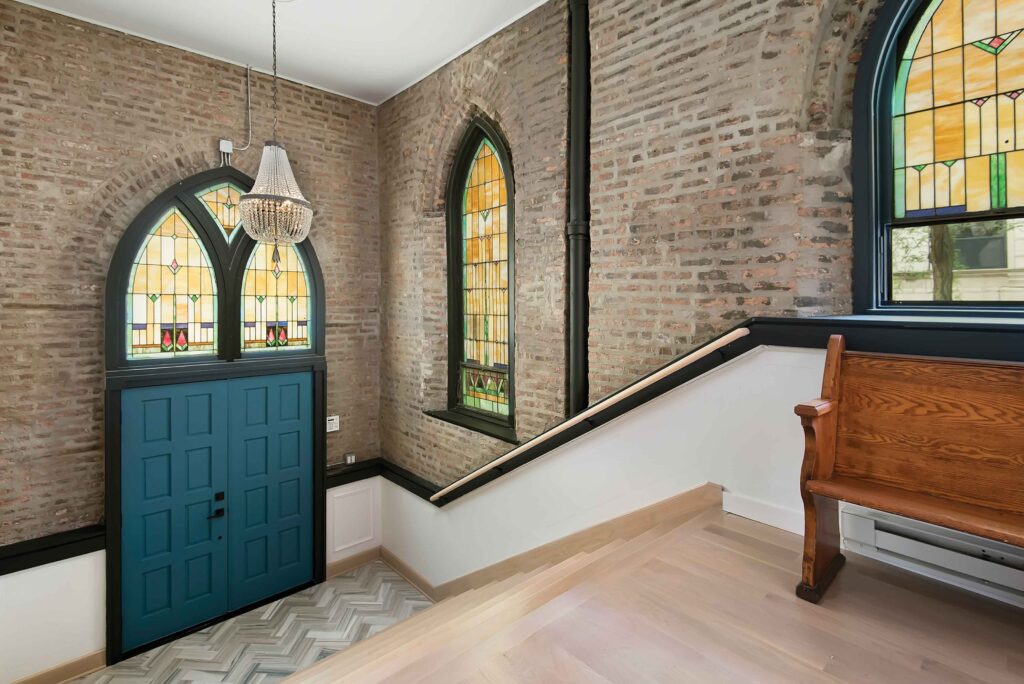
The team took care to preserve the former church’s historic details, including the bell tower, exposed brickwork and ceiling turnbuckles. Lighting was a huge challenge with the high-vaulted ceilings, but they worked around it by exposing the structure’s original wood beams and black metal supports. This resulted in an imposing main room with ceilings soaring to 7.6 metres (25 feet).
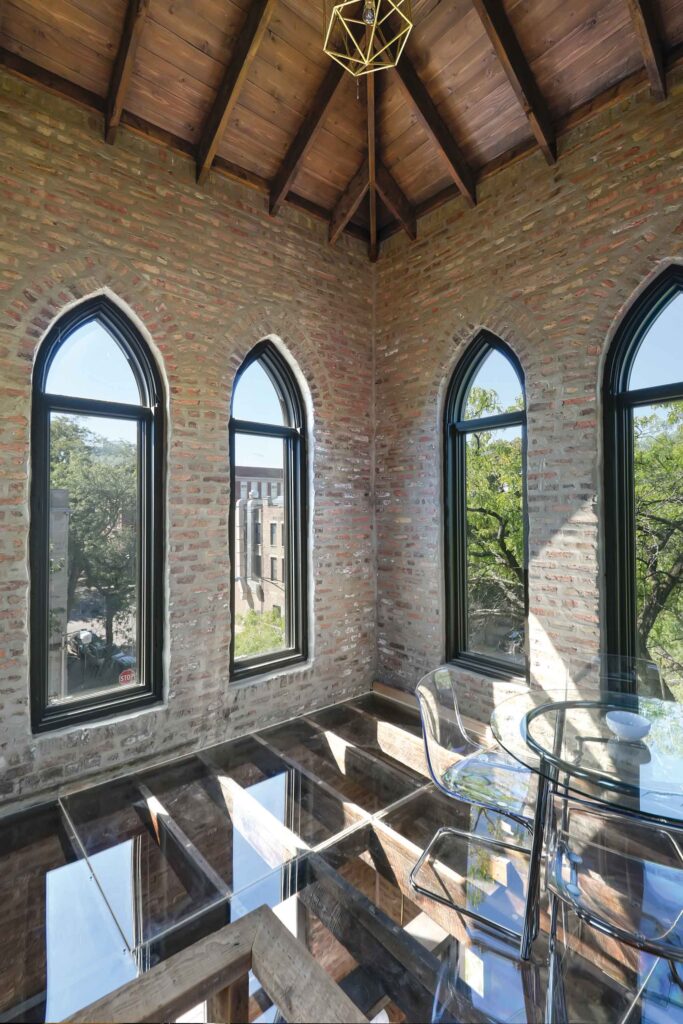
Entry to the house is granted through a blue door with stained-glass arches above it, which Thelen preserved from the original design. “The front door is one of the few things we didn’t change,” said Thelen. “The team thought the shade was both traditional and modern, setting the tone from the first moment one walks in.”
Sitting in the entryway foyer, hemmed in by exposed brick walls, is a symbolic pew from the original 1901 church. The so-called ‘great hall’, with its high ceilings, has an open layout that comfortably merges the kitchen, dining room and sitting area. Thelen made use of white oak with a custom white-wash stain for the wood flooring to create a warm and cosy feel.
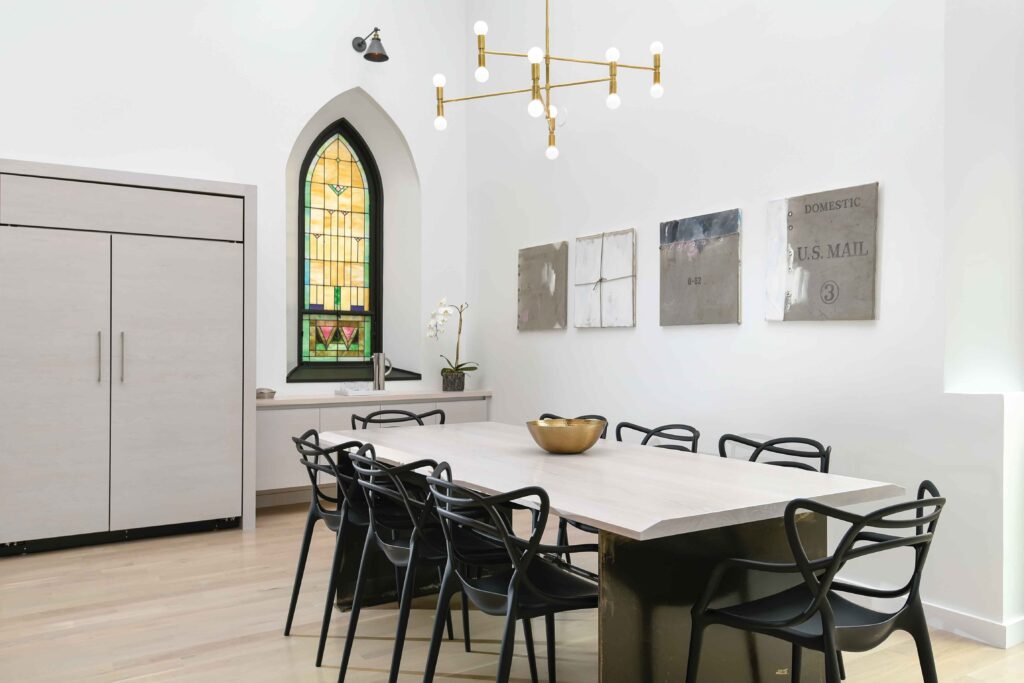
Over the kitchen’s gas range is a giant stained-glass window with frames that were painted black. “We wanted to restore the windows and make them a prominent feature of the home,” he said. At the large central island, five counter-height stools line up to face the gothic arches, whose transparent central panes reveal the street view beyond.
A black floor-to-ceiling chimney with integrated firewood storage stands in sharp contrast to the white painted walls. The two-sided, see-through wood-burning hearth and fireplace it houses is shared by a separate living room opposite the main area.
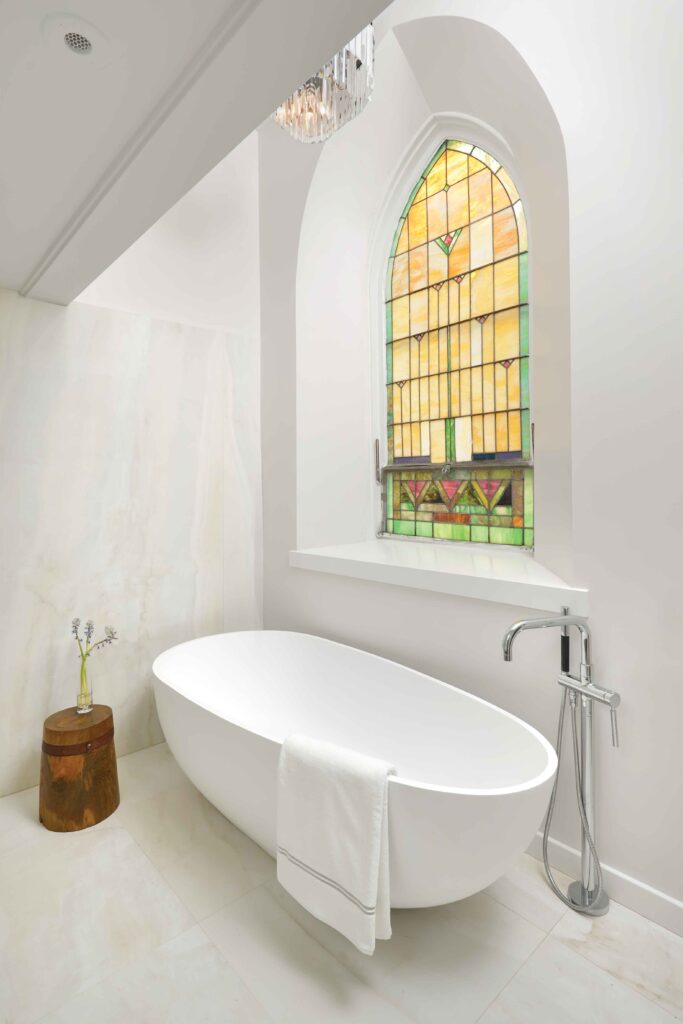
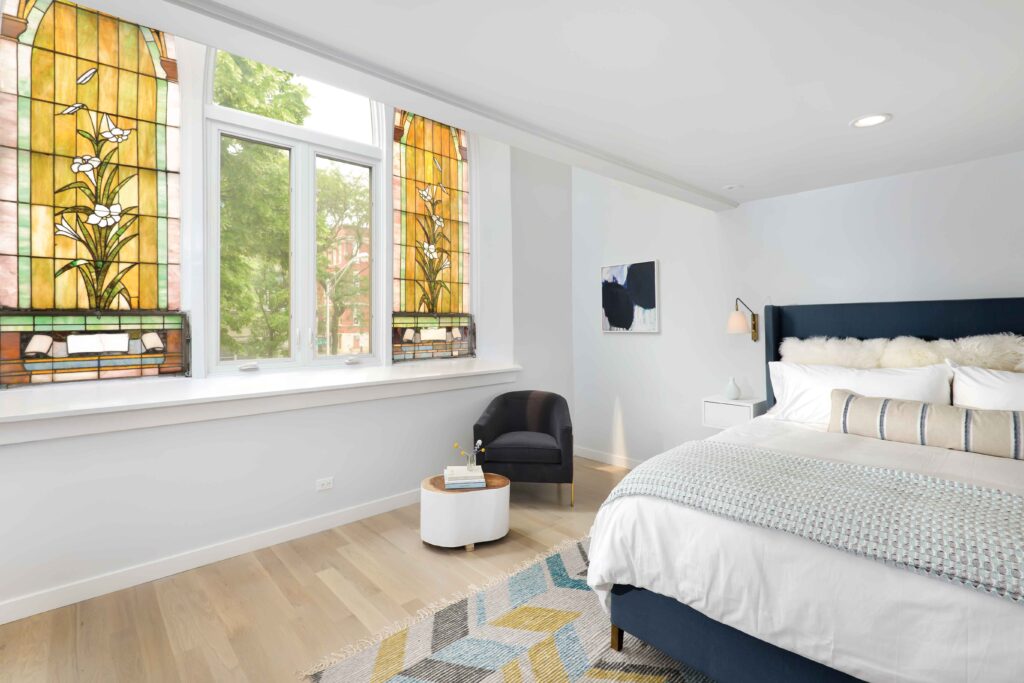
From above, a second-floor balcony looks down into the centre of the home, while a sliding door opens onto a backyard terrace. The master bedroom was designed with floating nightstands and a two-tiered ceiling hanging over the bed. The master bathroom is the site of one of Thelen’s favourite vignettes: a picture-perfect resin bathtub under a glittering chandelier and stained-glass window.
The bedroom created for the homeowners’ son contains fun elements, led by a floor-to-ceiling rock-climbing wall made from cement plaster. A sliding bar door leads to the en-suite bathroom, where tiles are inspired by the city’s rapid transit system and hexagonal patterns embellish cement floors.
The daughter’s room was also given a light-hearted touch with a hanging swing chair and a short ladder leading up to a loft and play area. The bathroom is tiled with colourful Moorish patterns. Over the tub is a cut-out window, bringing fresh air and natural light into the room.
The same cut-out design was repeated in the nursery, whose rectangular opening also revealed the home’s main living area. The nursery’s bookcase conceals a pull-down bed, enabling its conversion into a guest room.
The home’s pinnacle, though, is the bell tower, which once housed a furnace with panelled windows. Thelen transformed the entire area using glass floors and new windows, which offer a stunning view of downtown Chicago’s city lights.
This property’s days of serving as a house of worship are long gone, but those who live there now will likely be singing the praises of Thelen’s sophisticated and innovative approach to design.