

Sevens Heaven: Five decades after Hong Kong’s first tournament, tries still excite and unite the community
The Hong Kong Rugby Sevens did not start as a spectacle at kick-off in Happy Valley half a century ago. It began, as many enduring cultural institutions do, almost accidentally. Back then, the sport existed on the margins. Rugby was played largely within the expatriate community, sustained by club culture and social networks that operated somewhat apart from the city’s mainstream consciousness. In this context, the tournament’s role in bringing the city and people from around the world together over an oval ball for an exhilarating long weekend is a remarkable feat.
Hong Kong was a very different city in the mid-1970s; smaller, rougher at the edges, and still negotiating its identity as an international hub, it was defined more by transit and trade than by lifestyle. Skyscrapers had not yet fully asserted the skyline’s authority, and while finance was growing, it had not yet become the city’s dominant narrative. The prevailing mood was industrious rather than expressive.
When the idea of hosting a Rugby Sevens tournament was first proposed during discussions between the Hong Kong Rugby Football Union and then sponsors Rothmans and Cathay Pacific, it carried none of the ambition or theatrical scale that would later define it. There was no sweeping cultural blueprint, no strategic ambition to manufacture a global brand.
The shortened format of Sevens – seven players per side for rapid matches – appealed for practical reasons. It allowed multiple games to be staged across a single weekend, making travel worthwhile for visiting teams. It was efficient, compact and manageable. In a city that valued efficiency above excess, that practicality was sufficient justification.
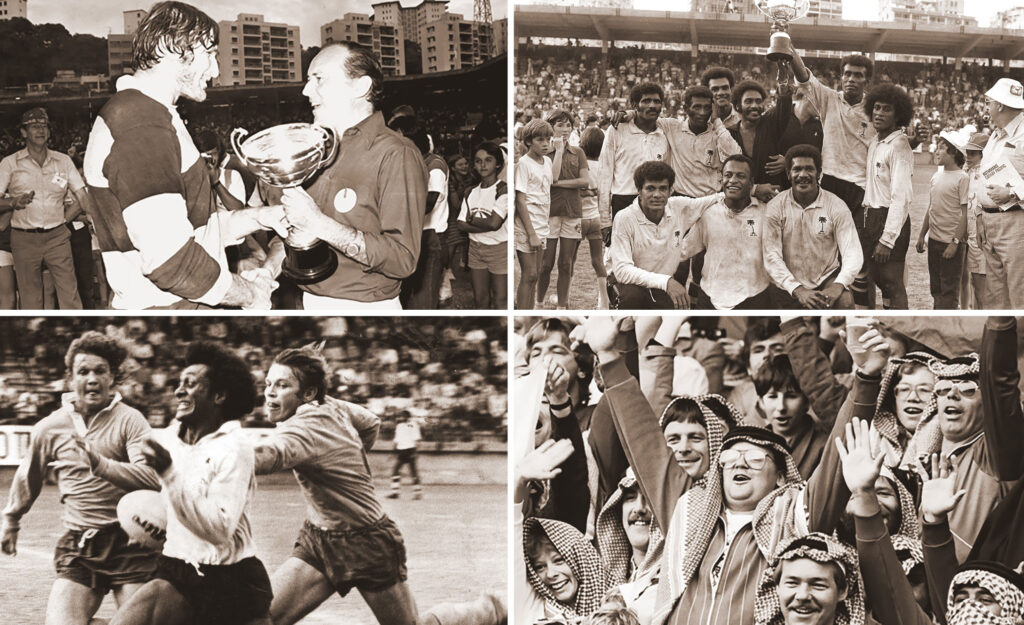
Rugby Roar
Yet that modest premise proved quietly transformative. When the first Hong Kong Sevens took place in 1976, featuring teams from across Asia and the Pacific, it did more than fill a sporting gap. It positioned the city as a regional meeting point at a time when global connectivity had not yet entered everyday vocabulary. Hong Kong’s economic role as an intermediary between continents found a cultural parallel inside the stadium. Teams arrived from different countries; supporters followed; flags appeared in the stands. For a few days, the city’s outward-facing identity condensed into a shared physical space.
What distinguished the tournament in its early years was not only the quality of play but the atmosphere that began to form around it. The shortened format generated momentum. Matches were brief, intense and closely scheduled, leaving little room for inertia. The pace encouraged constant engagement, with spectators becoming animated participants. The crowd responded collectively to sudden tries and dramatic turnovers. Laughter, chanting and applause moved in waves.
Since the Sevens grew organically, it feels fundamentally different from other large-scale gatherings. Its character formed through repetition – staged on the same weekend, year after year – and through the steady layering of memory. Attendees learned the rhythm of the event almost instinctively. They knew when anticipation would peak and when energy would dip, and this shared familiarity reduced the distance between strangers.

Success and Fancy Dress
As Hong Kong established itself as a financial powerhouse and global crossroads in the 1980s and 1990s, the Sevens evolved alongside it. The tournament broadened its international reach and migrated venues – from the Football Club, where 3,000 spectators watched the debut one-day event, to the 28,000-capacity Government Stadium in 1982, which was modernised in the 1990s and renamed the Hong Kong Stadium, to the spanking new 50,000-seat Kai Tak Stadium last year. The Sevens embedded itself into the city’s annual calendar, becoming a fixed point in an environment otherwise defined by constant acceleration.
The tournament culture was shaped more by the people who attended than by official programming. Traditions accumulated gradually. Attending in fancy dress emerged not as orchestrated fashion statements but as spontaneous gestures among groups of friends. One year’s joke became the next year’s expectation. The humour was playful, and the visual chaos in the stands signalled collective belonging rather than curated identity.
This ethos was already cemented by 1997 when the tournament achieved global recognition – this was the year Hong Kong hosted the Rugby World Cup Sevens, and its success was instrumental in the launch of the World Sevens Series in 1999. Loud, irreverent and communal, the emphasis rested on a raucous collective mood – epitomised by the alcohol-fuelled party atmosphere of Hong Kong Stadium’s South Stand – rather than individual performance.
People were absorbed into a larger current of energy. Expertise in rugby was welcome but unnecessary. Enthusiasm was the only requirement, and the crowd functioned as a temporary community, unified by rhythm rather than background.

Communal Party
Until this day, exuberance coexists with inclusivity during the Sevens weekend. Families share sections with longtime supporters and first-time visitors. Colleagues temporarily suspend workplace hierarchies. Conversations unfold without formal introduction. Groups select shared costume themes that transform them into collective characters. The result is an egalitarian spectacle in which participation matters more than polish. The stands resemble a living collage, constantly shifting yet unified.
Beyond the stadium, the city subtly reconfigures itself. Bars and restaurants function as informal meeting points, encounters between strangers occur with unusual ease, and the streets feel even more vibrant. The tempo of daily life adjusts, if only briefly. The Sevens reframes Hong Kong’s intensity, and energy becomes celebratory rather than transactional.
While the tournament does not promise reinvention or transformation, it permits suspension of boundaries between economic status and cultural divide, between locals and expatriates, between residents and visitors. In a city known for discipline and efficiency, collective exuberance carries symbolic weight. The permission to relax, to cheer loudly and dress absurdly feels restorative – and because that permission is shared, it rarely tips into bad behaviour or mayhem.
Although social media captures fragments of the weekend, the memory of the Sevens resides in sensation: tired legs from standing, hoarse voices from chanting, sun-warmed skin or soaked to the skin – monsoon-like downpours are not uncommon on the tournament weekend – and the faint disorientation of Monday morning. These embodied traces anchor recollection more powerfully than photographs.
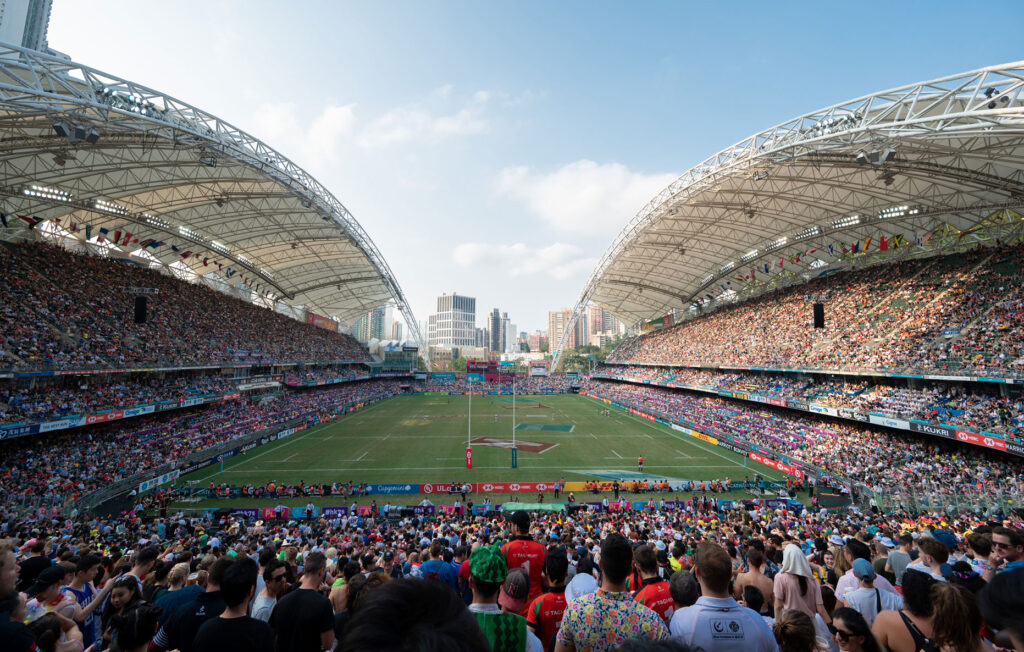
Inclusive Scores
As the Hong Kong Sevens has matured over 50 years, it has absorbed social change without abandoning its foundations. Women’s rugby has gained deserved prominence, and youth engagement has expanded. Local representation has deepened, reflecting Hong Kong’s evolving demographics. These developments extend the tournament’s inclusive spirit.
By Sunday evening, as final matches conclude and the crowd thins, the release subsides gently. Costumes are folded away until next year. Bars quieten, and the city resumes its habitual tempo. Yet a subtle recalibration lingers. The Sevens endures because it offers continuity within change. It is not spectacle engineered for consumption, but ritual sustained by return.
From 17-19 April this year, Hong Kong will gather once again over multiple rugby matches, heralding recognition of shared history, shared space and shared release. The Sevens is not about the self; it champions collective presence and community – and that enduring simplicity remains its quiet distinction and lasting relevance.
For many residents, particularly those who have witnessed Hong Kong’s rapid economic and political transformations, the Sevens acts as a temporal anchor. The city has weathered cycles of prosperity and uncertainty, demographic change and shifting global relationships. Neighbourhoods have been reshaped; industries have risen and receded. Through these fluctuations, the Sevens has remained. Its recurrence provides continuity in a landscape often defined by impermanence.