
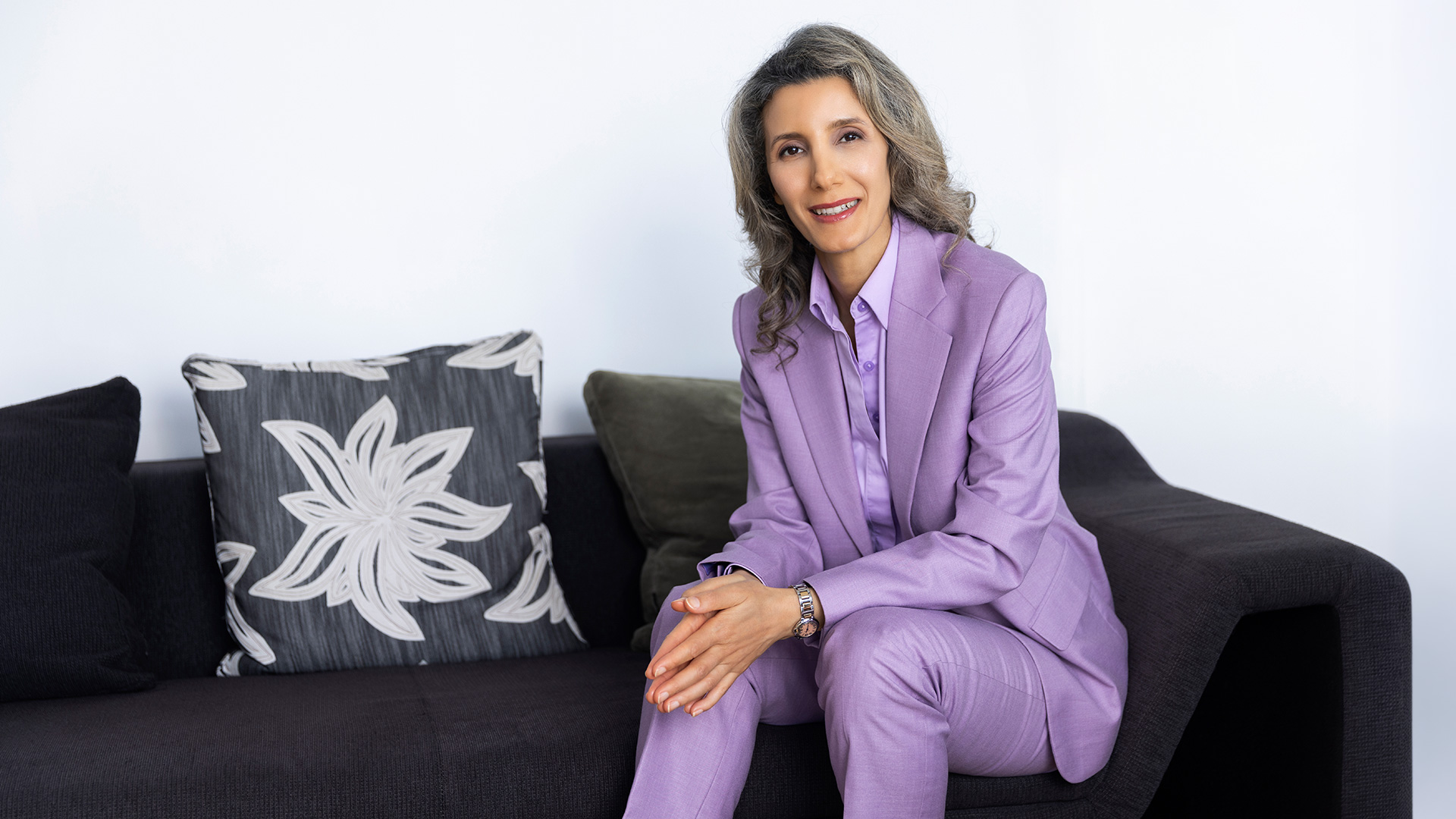
Mind Master: From rockets to relaxation, Renewed Edge Hypnotherapy Centre’s Christine Deschemin charts a new path in wellbeing
Christine Deschemin’s calm, sun-lit abode in Repulse Bay is the ideal environment to discuss stressors and sleeping patterns. As we admire her lush-green mountain and sea views, the CEO of Renewed Edge Hypnotherapy Centre suddenly digresses with a laugh: “And right over there lives one of the richest tycoons in Hong Kong. And over there is a celebrity.” It’s actually an apt introduction: her approach to mental health, the panorama is both grounding and expansive – rooted in science, open to possibility.
Deschemin’s CV reads like a page-turning novel that begins with aeronautical blueprints and ends with guided breathing tracks. Earning a Master of Science degree from École Polytechnique and an MBA from Harvard Business School gave her razor-sharp analytical tools and business savvy. But early on, she discovered that systems thinking could be applied to a system far more intricate than a rocket: the human mind. Childhood inquisitiveness, questions about flight mechanics and an interest in human behaviour grew into a career that blends engineering precision with clinical compassion.
“I grew up in an environment that celebrated curiosity and problem-solving,” shares the French national, who came to Hong Kong in 2012 as a wealth manager. After years of optimising aeronautics and making decisions in high-pressure banking environments, she realised that the most consequential system to improve was human wellbeing. The pivot felt less like an escape and more like an upgrade: same rigour, but new, and profoundly human, payoff.

Fencer, Financier, Founder
The certified hypnotherapist is no stranger to pressure. As a former competitive fencer, she learned to size up the opposition, react in milliseconds, and keep composure under duress. “In épée, you’re constantly reading your opponent and adjusting tactics,” she says. Those instincts proved invaluable when launching her hypnotherapy centre a decade ago, and the digital suite that followed. Entrepreneurship, she argues, is a tactical sport: preparation, repetition, discipline and the willingness to learn from every touché.
In 2020, Deschemin released the UpNow app to bring self-hypnosis to anyone with a smartphone. The app’s self-hypnosis downloads were developed to make mental health affordable and portable, an idea that felt urgent as the Covid pandemic frayed sleep and increased anxiety worldwide.
An early testimonial still moves her: a woman in her 60s, living far away, who reported sleeping again after using the app. “What struck me most was her gratitude for having access to efficacious interventions at an affordable cost,” she recalls. The story is evidence of what she terms her core mission: democratising access to quality care so suffering no longer depends on postcodes or bank accounts.

Where Science Meets Soul
Precision empathy is the secret sauce. Her work is deliberately multidisciplinary; hypnotherapy, psychology and digital therapeutics are strands woven into a single rope. “École Polytechnique taught me to think in systems and demand mathematical precision,” she explains. While at Harvard, she learnt how to scale solutions. The result: evidence-based programs that feel humane, not mechanical.
Her hypnotherapy downloads were created and voiced by clinicians and crafted using techniques with strong clinical roots (including elements of neuro-linguistic programming and mindfulness). Rejecting the binary that pits scientific rigour against compassion, she champions “precision empathy”, using data to determine what works, then delivering it in ways that respect people’s lives, cultures and constraints.
Asia presents unique challenges to the hypnotherapist: stigma, a performance-driven culture, and uneven access to care. She addresses stigma by reframing mental health as performance optimisation rather than weakness. Digital delivery lowers cost barriers and preserves privacy, which is critical in communities where face-saving matters.
She’s optimistic about culturally adapted models. “Digital therapeutics allow us to reach populations who would never walk into a therapist’s office but will engage with an app,” she says. Her strategic aim is to create programs that feel both culturally relevant and clinically reliable. Small downloads can realise big life changes.
Stories That Count
Beyond metrics, Deschemin is motivated by stories: the executive who reclaimed sleep, the athlete who regained focus, the midlife woman who found relief during menopause. These aren’t anecdotes to her; they’re a north star. The note from the woman who hadn’t slept in weeks during the Covid crisis demonstrated that accessible interventions can restore everyday life in ways often dismissed by conventional healthcare.
Running a company is like managing a team bout in fencing. She brings a governance-minded clarity to growth, and board roles taught her the balance between risk and innovation. She empowers colleagues with autonomy and clear resources, fostering a culture of competence and trust. “I give people challenging goals and the tools to achieve them, then get out of their way,” she says. The result is a virtuous cycle where empowered teams iterate quickly and responsibly.
Practical Zen
Deschemin is candid about the personal cost of her healthcare entrepreneurship: it’s easy to neglect one’s own well-being. So, she has daily non-negotiables, including sufficient sleep and long walks in Hong Kong’s hills. Nature is her reset button: a place to process, plan and replenish. These rituals keep her grounded so she can keep giving, because she notes, “you cannot pour from an empty cup”.
Looking ahead, she wants to offer a suite of evidence-based digital therapeutics for menopause, anxiety, sleep, gastrointestinal conditions and stress-related disorders. Her five-to-10-year goal is to integrate these programs into healthcare systems and insurers’ coverage, so evidence-based digital therapies are standard care rather than fringe options. “Success is impact at scale, and for me that means millions finding relief where none existed before,” she says.
Clear View, Clearer Mind
As our visit ends, Deschemin gestures toward the bay and the mountain. The view is more than scenic, it’s metaphorical. “When your vantage point is clear, you make better decisions,” she says. The same goes for mental health: a clearer inner view, less cluttered by stress and distorted thinking, allows people to act with agency and grace. The vista from her house is a daily reminder that perspective matters. Whether you’re facing a tycoon’s mansion or the turbulence of burnout, a clean line of sight makes the way forward easier to see.
The compassionate hypnotherapist would likely appreciate the subtlety of the pun that she’s built a career helping people get their minds ‘up now’. From rocket science to guided relaxation, she’s proving that a clear view – of the horizon and the mind – makes all the difference.
Interview, Text & Art Direction: Joseff Musa Photographer: Jack Law Videographer: Iris Ventura